If you are selling a Rs. 15 Crore luxury villa in North Bangalore, or a Rs. 50 Lakh custom interior design package, your buyers do not browse the web like they used to. They are no longer typing simple search queries into Google and scrolling through pages of sponsored links. Instead, they are asking ChatGPT, Claude, and Perplexity complex, context-rich questions.
They ask: "Which luxury interior design firms in Bangalore specialize in minimalist, mid-century modern design and have a track record with premium gated communities like Adarsh Palm Meadows?" Or, "Who are the top developers in Hyderabad offering large luxury apartments with private pools and a focus on sustainable materials?"
When these high-intent, high-net-worth buyers ask these questions, does the AI mention your brand? Or does it point them directly to your competitors? This is the core challenge of Generative Engine Optimization (GEO) for high-ticket brands. If you are not in the AI's training data or context window when a buyer is filtering options, you simply do not exist in their consideration set.
The Paradigm Shift: From Keywords to Trust Nodes
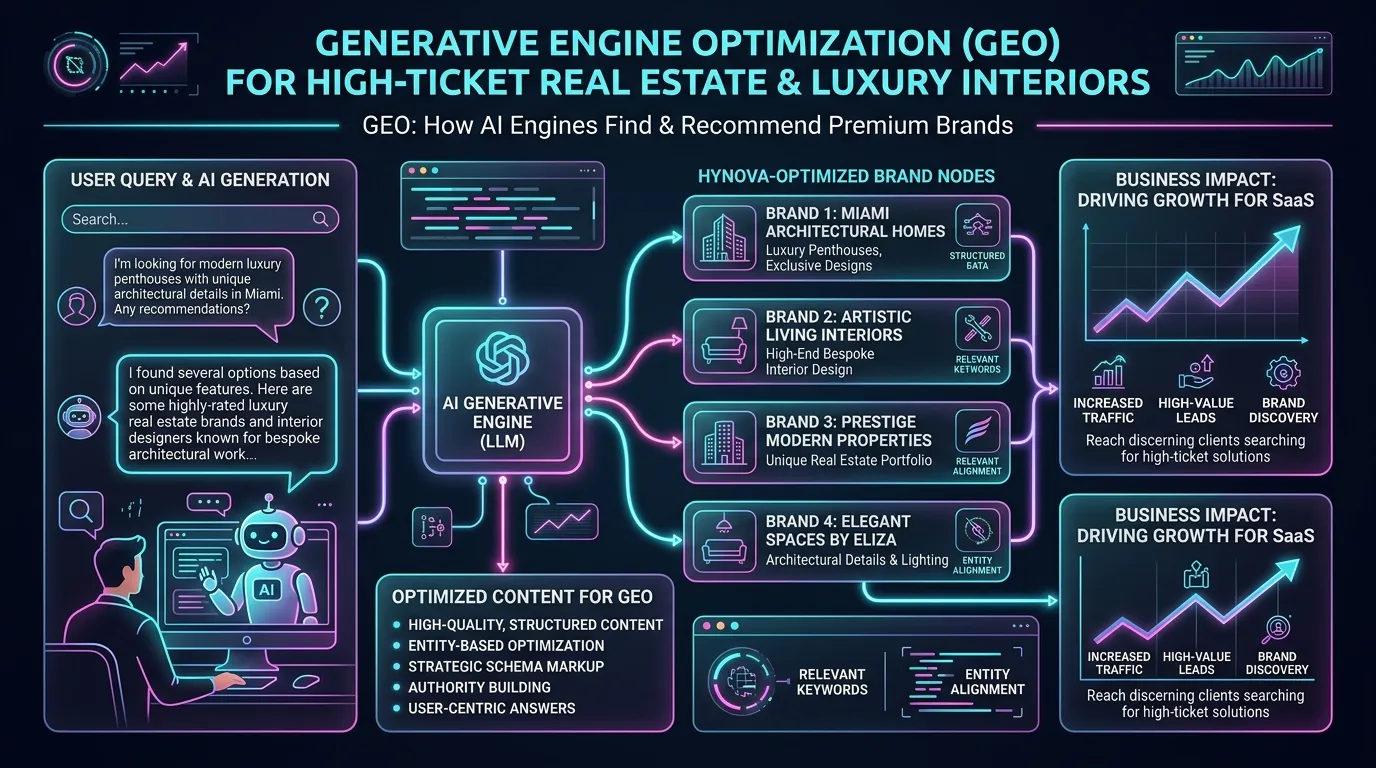
In classical SEO, you won by targeting high-volume keywords, building domain authority, and stuffing pages with links. But LLMs do not look at search query volume. They are semantic engines built to synthesize consensus. They search for trust, context, and structural clarity. This shift changes the game in three fundamental ways:
- Zero-Click Consensus: The AI extracts details from the web, forms a synthesis, and presents it directly. The click to your website only happens after the AI has recommended you.
- Domain-Specific Depth: Incumbent brands with million-dollar ad budgets can easily win Google Ads bids. But they cannot force an AI engine to recommend them if the web's semantic consensus points elsewhere.
- Contextual Relevance: High-ticket buyers ask for hyper-specific combinations (e.g. location + style + budget + project timeline). Only brands that map their project profiles correctly will fit the filters.
For high-ticket sales, the AI is the ultimate concierge. If the concierge doesn't know your portfolio, you are locked out of the room.
The Four-Step GEO Framework for Premium Brands
1. Map Your Structural Context (Project-Level Schema)
LLMs are excellent at reading structured data. If you run a luxury interior studio, every project in your portfolio should have dedicated Schema markup on your website. Use the DesignObject, LocalBusiness, and RealEstateAgent schemas. Do not just upload photos; specify the materials used, the design style (e.g., Japandi, Italian Modernism), the locality, and the project scope. This enables semantic parsers to match your projects with conversational filters.
2. Build Editorial Citation Loops
AI search engines cross-reference multiple sources to confirm authority before recommending a high-ticket service. They crawl editorial features on platforms like Architectural Digest, Elle Decor, premium design blogs, local business journals, and niche forums. Securing mentions on these platforms isn't just for brand prestige anymore — it is the digital proof the AI needs to cite you as an authority.
3. Authoritative Case Studies (The "Intent-Matching" Page)
Stop publishing thin portfolio pages with just "before-and-after" images. Write deep, narrative-driven case studies. Describe the design challenge, the client's criteria, the structural solutions implemented, and the specific premium brands/materials used (e.g., custom teak wood, automated lighting systems, Italian marble). AI crawlers read these detailed logs to understand your operational capabilities and design philosophy.
4. Manage Third-Party Reviews & Digital Footprints
LLMs rely on external verification to determine trustworthiness (E-E-A-T). They actively scan Google Business Profile reviews, Houzz reviews, premium directory listings, and discussions on local forums. A consistent stream of authentic, text-heavy reviews that mention specific details about your service quality and communication style will directly influence the engine's willingness to recommend you.
We implemented this semantic mapping system for a premium design studio in Indiranagar. By restructuring their case studies around conversational design styles and building authoritative external citations, we moved them from unlisted to the top-recommended firm in Perplexity for premium interior queries within Bangalore — resulting in direct, organic pipeline growth without a rupee spent on Google Search ads.
Audit Your AI Visibility Today
The transition from keyword search to conversational AI recommendations is already happening. High-ticket buyers value their time; they will increasingly let Perplexity and ChatGPT filter out the noise. If your business isn't optimized for these engines, your pipeline will slowly dry up, even if you keep bidding on expensive Google Ads.
At Hynova Studio, we build the underlying systems that connect your digital footprint, portfolio structure, and external citations into an authority engine the AI cannot ignore.
See What ChatGPT and Perplexity Say About You
Get a custom AI Visibility Audit for your brand. We'll show you exactly how the top engines rank your business today and provide a clear roadmap to capture luxury buyers.
Get Your Free AI Audit →