If you hang around startup offices in Indiranagar or HSR Layout, you’ve probably witnessed a familiar scene. A Slack channel or WhatsApp group lights up, and a founder drops a link: "Guys, just posted. Please like and comment for the algorithm!" We’ve all done it. We’ve all chased the quick burst of vanity metrics, hoping the LinkedIn gods would smile and route our thoughts to a prospective buyer in San Francisco or London.
But by mid-2026, those engagement pods aren’t just useless — they are actively harmful. LinkedIn has rolled out its most aggressive algorithmic shift in years: the transition to a purely interest-based, authority-led distribution system (powered by their semantic AI core, code-named the 360Brew model). The old playbook of "reach-chasing" — hiring a Rs. 15,000-a-month ghostwriter to post generic, hook-heavy listicles about "5 things I learned from Steve Jobs" — has officially hit a wall. If your content lacks deep practitioner authority, the algorithm quietly buries it.
Here’s the good news: this update is a massive gift to B2B founders who actually know their domain. You no longer need to look like an influencer. You just need to build a system that projects your genuine, hard-won authority to the right people. Let's break down how this works.
The Mechanics: What Changed Under the Hood in 2026
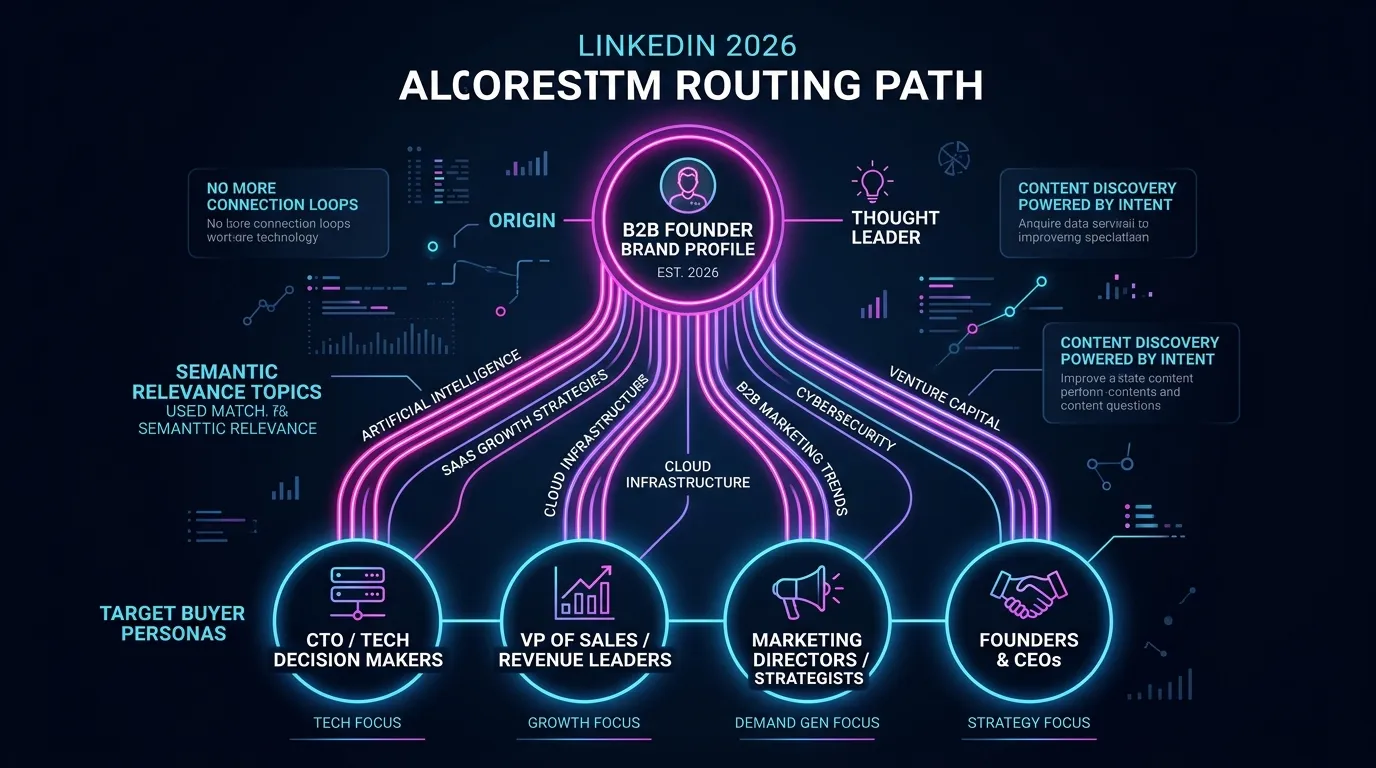
Historically, LinkedIn prioritised connection-level viral loops. If three of your connections liked a post, it showed up in their connections' feeds, regardless of the topic. This led to the rise of "broetry" and generic, high-volume posting designed to farm easy interactions.
The 2026 algorithm dismantles this structure in three major ways:
- Semantic Routing Over Connection Count: LinkedIn now reads your post through an AI model that determines its topic, depth, and target audience. It then distributes it to users who exhibit active interest in that specific topic, even if they have zero connection to you. Your first-degree network is no longer your primary distribution limit.
- Dwell-Time & Depth Signals: The algorithm weighs how long a user stays on your post (dwell-time), whether they save it, and if they share it. It penalises click-bait hooks that lead to shallow, quick-bounce content.
- The Death of the Pod: Quick, one-word comments ("Great post!" or "Agreed!") from the same group of people are heavily discounted. The algorithm prioritises long-form, analytical comments that spark genuine debate.
The 2026 algorithm has one primary filter: Does this post look like it was written by an active practitioner, or is it recycled AI fluff?
Why Hired Ghostwriters Are Costing You Pipeline
Many founders think they’ve solved LinkedIn by hiring a freelance writer or a generalist agency to manage their profile. The typical agency proposal promises 3 posts a week, a custom banner, and a promise of "positioning you as a thought leader."
In 2026, this approach is a liability. Generalist writers don't know the nuances of your product or your customer's pain points. They default to high-level, generic summaries. Because LinkedIn's semantic AI evaluates the technical depth and vocabulary of your posts, these generic lists are flagged as low-quality. You might see a few polite likes from your team, but your target buyers will never see the post. Worse, you are training the algorithm to treat your profile as a source of low-depth content.
The 4-Step Playbook for Founder Authority
If you want to leverage the new interest-based distribution without spending three hours a day on your phone, you need a structured approach that prioritises depth over frequency.
1. Document, Don't Preach
Stop trying to sound like a philosopher. Instead, treat your profile as a public log of the problems you are solving. Share actual spreadsheets, system architectures, SQL queries, or the exact timeline of a failed product release. Real practitioners love detail. If you are a dev-tool founder, post the code block that caused a database bottleneck. If you run a marketing SaaS, show the exact campaign setup that failed and what you changed. The algorithm rewards these hyper-specific, high-dwell-time assets because they are unique and highly saved.
2. Build the "Document Stack"
PDF carousels (documents) remain the absolute highest-converting format on LinkedIn for one reason: they naturally build massive dwell-time. But instead of the usual 5-slide decks with generic quotes, build 10-slide step-by-step guides. Walk through a complete workflow. Make it so valuable that your target buyer clicks the "Save" button. On LinkedIn, a Save is worth ten Likes; it tells the algorithm that your content is an authoritative resource.
3. The Comment-First Strategy
You do not need to write three original posts a week. Writing one deep, highly valuable post per week, paired with a daily commenting routine, is far more effective. Every morning, identify five posts from industry peers, prospective clients, or category leaders. Write a thoughtful, 3-to-4 sentence critique or expansion on their ideas. In 2026, LinkedIn distributes high-value comments to the feeds of other users. A single insightful comment can drive more high-intent profile visits than an entire week of posting mediocre content.
4. Turn Your Profile Into a B2B Funnel
All the authority in the world is useless if a profile visitor leaves without taking action. Your headline should not be a generic "Founder & CEO @ Synaptiq". It needs to state exactly who you serve and what asset you have for them. Use the featured section to host a link to a high-value, self-serve tool — like a free scorecard or a technical audit — rather than just linking to your home page.
We saw this shift play out directly with our B2B education client, Crestmont University. By moving their leadership team away from generic campus updates and routing their content into deep, structured breakdowns of B2B enrollment automation, we proved that when founders write with genuine domain depth, the pipeline follows.
The Resource You Actually Own
At the end of the day, social platforms are rented land. Algorithmic changes will happen again. But the authority you build by documenting your work is yours to keep. The founders who win in 2026 are not the ones trying to hack the feed; they are the ones who treat their personal brand as an extension of their product's engineering quality. If you want to set up an automated system that captures this authority without eating up your weekends, that’s exactly the machine we build. Let’s talk about how to wire it for your studio.
Build Your Authority Engine
Get a custom strategy on how to position your founder brand for the 2026 algorithm, build high-dwell carousels, and convert profile traffic into pipeline.
Book a Founder Branding Call →