Two weeks ago a founder forwarded me his Google Ads account at 11pm with a single line: "Spend doubled, leads didn't." Nothing was broken. His Performance Max campaign had simply done what Google now nudges every account to do — explore. On 15 June 2026, Google rolled out a batch of bidding and budgeting changes, and the headline one, Smart Bidding Exploration, is now expanding to Performance Max campaigns that don't even run a product feed (Google's own announcement). Translation: the machine now has more permission to spend your money on queries it has never converted on, in the hope it learns something.
I'm not anti-automation — at Hynova we run on it. But there is a difference between automation you direct and automation you surrender to. Most founders are quietly sliding into the second. Let me show you where the line sits, and how to stay on the right side of it.
What actually changed on 15 June
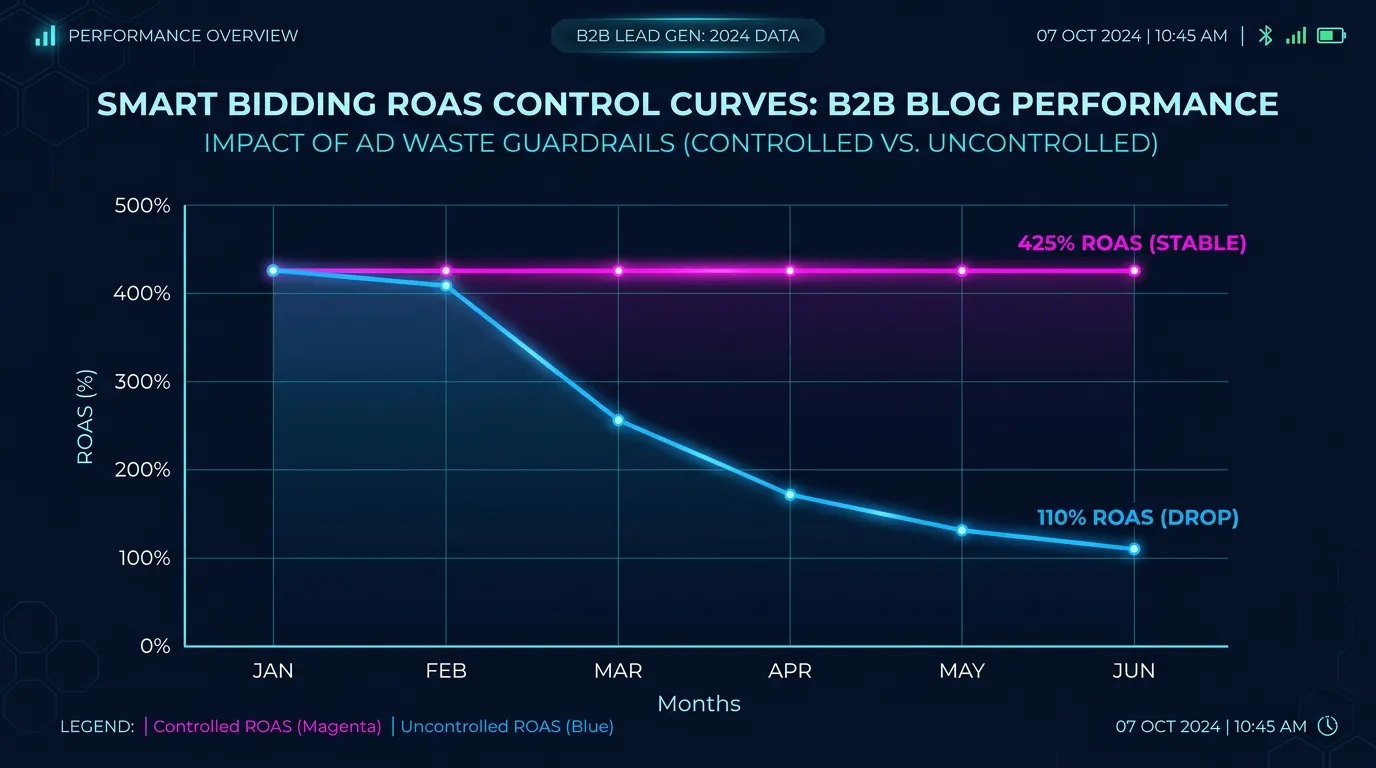
Three updates, but one matters most for your wallet. Smart Bidding Exploration lets Google's algorithm widen your ROAS boundaries to chase queries with unproven conversion history — and it is no longer limited to feed-based Performance Max. There's also a Promotion Mode beta for temporarily loosening bids during sale events, and a change to how budget-limited campaigns hit their targets, landing from 17 August (MediaPost, 16 June 2026).
Read the official wording again: "unproven conversion history" and "widen your ROAS boundaries." That is Google asking permission to be less efficient in the short term in exchange for reach. Sometimes that is the right trade. But it is a decision — and right now, by default, it is being made for you.
Automation doesn't remove the need for a strategy. It raises the price of not having one.
Why founders feel this more than enterprises
A large advertiser has an in-house team watching ROAS daily and a brand budget to absorb a rough fortnight of exploration. A bootstrapped or seed-stage founder in Bangalore or Austin has neither. When the algorithm "explores," it is exploring with the only ₹3 lakh or $4k you had for the month. The same feature that is a rounding error for an enterprise can be your entire pipeline for the quarter.
This is exactly why I keep telling founders: paid media is acquisition architecture, not ad management. The platform will happily run your ads. It will not happily protect your unit economics. That part is on you — or on whoever you trust to own it.
There's a quieter reason this stings for lean teams. Google's incentives and yours only partly overlap. Its model is rewarded for spending your budget efficiently across millions of advertisers; you are rewarded for one thing — profitable customers for your business this month. Most of the time those goals point the same way. Exploration is precisely the moment they diverge, because the platform is willing to "invest" your money in learning that benefits its system as much as your pipeline. You don't have to refuse that trade. You just have to be the one who sizes it.
The guardrail system we run
You don't beat automation with manual bidding and 2019 nostalgia. You beat it with structure that tells the machine where it is allowed to be creative and where it isn't. Here is the framework I give every founder before they touch a bid setting.
1. Separate proven spend from exploratory spend
Never let one campaign do both jobs. Keep a "proven" Performance Max or Search campaign locked to a tight target ROAS on your known winners, and run a separate, capped exploration campaign where you actually want Google to hunt. Now exploration cannot quietly eat the budget that pays your rent.
By splitting core catalog spend from experimental exploration budgets, our premium D2C clients protected their baseline at a profitable 12x ROAS while capping test waste at a flat ₹50,000/month.
2. Set a tROAS floor before you enable anything
Smart Bidding Exploration widens your ROAS tolerance. So decide the floor first — the return below which a sale simply isn't worth making — and set your target ROAS there deliberately, not at whatever the platform suggests. If you don't know your floor, you're not ready to automate; you're ready to gamble.
3. Review search terms and placements weekly, not monthly
Exploration shows up as new — and often junk — queries and placements. A weekly 20-minute review-and-exclude habit is the cheapest insurance you'll buy. The machine learns fast; so should your negative list.
4. Track CPL and CAC, not "conversions"
Google's dashboard will tell you conversions are up. Your bank account is the honest reporter. Tie ad spend to real cost-per-lead and customer-acquisition-cost, and ideally to pipeline value — not the platform's self-graded report card. We wire this into a single reporting view so the numbers can't hide.
When you should let it explore
To be fair to the update: exploration earns its keep when you have genuine room to scale, healthy margins, and clean conversion tracking feeding the algorithm good signal. A D2C brand with 4x margins and a year of purchase data should let Google hunt. A founder with thin margins, fuzzy tracking, and one product line should not — yet. The feature isn't the enemy. Using it blind is.
Do this before your next billing cycle
If you run Google Ads and haven't looked since 15 June, work through this list this week:
- Check whether Smart Bidding Exploration is on in your Performance Max campaigns — it may have switched on by default.
- Split proven vs exploratory budget into two separate, capped campaigns.
- Set a deliberate tROAS floor from your real margins, not Google's recommendation.
- Book a recurring weekly review of search terms and placements, and build the negative-list habit.
- Connect spend to CPL, CAC and pipeline in one view so the platform can't grade its own homework.
None of this is about distrusting AI. It's about staying the one who decides what "good" looks like. The founders who win the next year of paid media won't be the ones who automate the most — they'll be the ones who automate with the clearest guardrails.
Is Google spending your budget — or building your pipeline?
Book a 30-minute strategy call. We'll look at your account, flag where automation is leaking spend, and map the guardrails that keep ROAS yours.
Book a 30-Minute Strategy Call →